
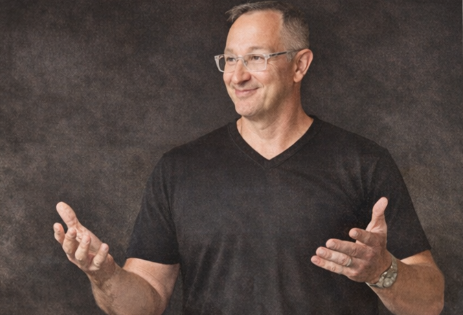
Hewitt, Texas — In the fluorescent-lit hallways of Baylor University’s Robbins College, a 47-year-old professor with six degrees and a sixth in progress is quietly revolutionizing how we think about failure. Dr. Toby Brooks isn’t just another academic with impressive credentials. He’s a former athletic trainer for the Las Vegas Raiders, a published author of 20+ books, the host of a global top 10 podcast, and a man who has built an entire philosophy around what he calls “becoming undone” — the necessary unraveling that precedes every meaningful reinvention.
But the story of how a kid from Golconda, Illinois (population: barely 600) ended up directing a teaching academy at a major research university while helping high achievers navigate their own identity crises is anything but linear. It’s a story of near-misses, midnight magazine deadlines, professional collapse, and the stubborn refusal to let a single career define a life.
The Boy Who Didn’t Know Athletic Trainers Existed
Growing up in the coal-country shadows of Southern Illinois, Toby Brooks was just another basketball-obsessed kid in a town too small for its own hospital. When he tore his ACL in high school, the injury was managed “pretty poorly” — there were no athletic trainers, no sports medicine clinics, just the painful realization that rural America often leaves its athletes to heal alone.
“I wanted to do what I could to make sure they avoided the kind of experience I had,” Brooks would later reflect. That personal trauma became a career compass. At Southeastern Illinois College, a two-year institution where he arrived as a first-generation student intimidated by the prospect of “big college,” Brooks discovered athletic training not as a profession, but as a calling.
Dr. Jonah Rice, then a faculty member at SIC, remembers the young Brooks vividly: “He demonstrated so many qualities for guaranteed success — intellect, work ethic, humor, and appreciation of his roots.” Rice taught Brooks’ very first college course — English 101 at 9 a.m. on a Monday — and would eventually, as president of the college, call to inform Brooks he’d been named a Distinguished Alumnus nearly two decades later.
From SIC, Brooks transferred to Southern Illinois University Carbondale, graduating in 1998 as one of the university’s top 25 graduating seniors. But it was at the University of Arizona where the trajectory shifted again. Working as a graduate assistant athletic trainer with the Wildcats’ women’s gymnastics, football, and baseball programs, Brooks discovered something unexpected: he didn’t just want to tape ankles and rehabilitate injuries. He wanted to understand the science of teaching — how knowledge moves from expert to novice, how coaches coach, how people actually learn.
“I had underestimated the importance of good teaching,” Brooks admits now. “I assumed that good teachers were born and not made.” The realization would reshape everything.
The Sideline Years: From NFL Locker Rooms to Magazine Deadlines
For the next decade, Brooks lived the dream of every sports medicine professional. He worked with USA Baseball’s national teams, spent time with the Oakland Raiders (now Las Vegas Raiders), served as head football athletic trainer at Liberty University, and worked with the Florida Firecats AF2 franchise and Southern Illinois Miners. The credentials accumulated: ATC, CSCS, performance enhancement specialist, youth fitness specialist.
But Brooks had a secret side hustle that would eventually become a second career. For eight years, he served as art and technical director for RPM Magazine, an automotive publication based in Canada with 40,000 monthly readers across 40 countries. While working full-time as a professor and athletic trainer, Brooks wrote over 500 feature articles for car magazines, sometimes pulling 48-hour production marathons to meet deadlines.
“At its peak, I was earning more money doing this side hustle… than I’d made as the head football athletic trainer at Liberty, working 60-hour weeks,” Brooks revealed in a podcast episode. The money wasn’t just for bills — it funded “an insane project car” and fed a creative hunger that sports medicine alone couldn’t satisfy.
This dual existence — academic by day, automotive journalist by night — revealed something essential about Brooks’ character: he refuses to be contained by a single identity. When COVID-19 devastated the print magazine industry and RPM’s advertising revenue collapsed, Brooks didn’t mourn the loss. He recognized it as another comma in a life full of semicolons.
The Lubbock Interlude: Building, Burning Out, and Breaking Through
In 2010, Brooks arrived at Texas Tech University Health Sciences Center in Lubbock, Texas. What was supposed to be a brief stop became a 14-year tenure that would test everything he thought he knew about success. As Program Director of the Master of Athletic Training Program and later Assistant Dean for Faculty Success, Brooks built programs, mentored faculty, and earned the Student Government Association’s Outstanding Faculty Award five times.
But something was happening beneath the surface. The man who preached work-life balance to his students was grinding himself into exhaustion. The side hustles, the academic demands, the pressure to produce — it was all unsustainable.
“I was defined by achievement — athlete, academic, overachiever,” Brooks wrote in his personal manifesto. “I chased titles, trophies, and the next big win, believing that success would bring lasting fulfillment. But when life unraveled — through burnout, loss, and a crisis of faith — I found myself staring at a stranger in the mirror.”
The breaking point came during the COVID-19 pandemic. Teaching a mental health course for athletic trainers, Brooks watched his students grapple with a reality he’d long ignored: the identity crisis that hits high achievers when their primary role — athlete, trainer, performer — suddenly ends.
“It isn’t something we talk about enough,” Brooks realized. “We assume people move on, get over it, and start the next season of life, but that’s not always healthy.”
That classroom epiphany became Becoming UnDone, a podcast that would explode into a global phenomenon. In just 18 months, the show ascended to the top 10% of podcasts worldwide, peaking at #4 in Apple Podcasts’ Education category and reaching listeners in over 100 countries. The premise was radical in its simplicity: interview high achievers — Olympic gold medalists, Navy SEALs, Grammy-winning artists, entrepreneurs, even his own children — about their moments of unraveling.
“Every one of these stories includes setback, adversity, loss, or failure,” Brooks notes. “The question is: What do we do with that?”
The Sixth Degree: A Professor Becomes a Student Again
In 2024, Brooks made a move that surprised even himself. After 14 years at Texas Tech, he accepted a position as Director of the Academy for Teaching and Learning at Baylor University — and immediately enrolled as a graduate student in the same department where he now serves as Clinical Professor.
At 47, Brooks is pursuing his sixth college degree: a Master of Science in Exercise Physiology from Baylor. He sits in the same classes as students he might one day teach, navigates the same Canvas learning management system, stresses over the same exams.
“The last thing I want is to be so far removed from that part of my awareness that I’m not a compassionate educator,” Brooks explains. “When my students hear me talk about having a test coming up, it creates a connection that wouldn’t exist if the mindset were simply, ‘I’m the professor, and they’re the student.'”
This isn’t performative humility. It’s strategic empathy — the same quality that makes Becoming UnDone resonate with burned-out executives and questioning athletes alike. Brooks isn’t just studying exercise physiology; he’s studying the student experience itself, gathering data on how modern learners navigate stress, technology, and identity formation.
The AI Imperative: Teaching in the Age of Disruption
As if six degrees weren’t enough, Brooks has positioned himself at the forefront of another revolution: artificial intelligence in education. As chair of Baylor’s Generative AI Working Group, he’s helping faculty navigate the ethical integration of AI into teaching and learning — a challenge that requires the same strategic thinking he once applied to injury prevention in professional athletes.
“His scholarly work centers on all aspects of human performance, and has expanded to include faculty mentorship, instructional excellence, and the ethical integration of emerging technologies such as generative AI in teaching and learning,” notes his official Baylor biography.
It’s a natural evolution for someone who has always operated at intersections: sports and science, teaching and technology, failure and growth. Brooks doesn’t see AI as a threat to education but as another tool requiring the same evidence-based approach he learned in athletic training.
The Entrepreneurial Spirit: From NiTROhype to Performance Fasteners
Long before “side hustle” became a buzzword, Brooks was living the entrepreneurial life. He founded and operates two companies: NiTROhype Creative (a graphic design and creative agency) and Performance Fasteners, LLC. He’s a two-time participant in the NSF Regional iCorps competition, completed the 2019 iLaunch competition, and was a member of the 2020 cohort of the TTU Innovation Hub Accelerator Program.
This entrepreneurial streak runs deeper than mere business interest. It’s about creating systems — whether for teaching, training, or commerce — that outlast individual effort. “Strategic thinkers don’t just do more, they do better,” Brooks argues in The Professor’s Playbook, his second podcast focused on sports science and education.
The Historian’s Eye: Preserving Forgotten Stories
Between the podcast episodes and academic papers, Brooks has authored over 20 books — including two works of historical nonfiction that reveal his deep connection to Southern Illinois heritage. Season of Change: Baseball, Coal Mining, and a Small Town’s Struggle to Beat the Odds (2011) tells the story of the 1948 West Frankfort Cardinals, a minor league baseball team that brought hope to a coal town before the mines closed and the team folded.
The book isn’t just sports history; it’s social archaeology, excavating a moment when “West Frankfort had a bigger population than Marion… a trolley and three movie theaters” before the 1951 mine explosion changed everything. Brooks discovered the story by accident — a correction from an old man at a Marion Miners game who informed him that professional baseball had deeper roots in Southern Illinois than anyone remembered.
“I wasn’t going to do a book, but I fell in love with the story,” Brooks admitted in a 2008 interview. That love affair with narrative — with the human stories behind statistics — permeates everything he creates.
The Philosophy of UnDoing
What makes Brooks’ work matter isn’t the impressive resume or the celebrity guests on his podcast. It’s the radical proposition that failure isn’t the opposite of success but its prerequisite. In a culture obsessed with “crushing it” and “hustle culture,” Brooks offers a counter-narrative: that the coming apart isn’t the end of the story, it’s the beginning.
“If we see [failure] as a comma or a semicolon, something unfinished, it changes everything,” he argues.
This philosophy isn’t abstract theory. Brooks has lived it — through the magazine collapse, the professional burnout, the identity crisis that left him staring at a stranger in the mirror. His work with high achievers through Becoming UnDone and his personal coaching platform isn’t about motivational platitudes. It’s about the hard, messy work of rebuilding identity when the external validation disappears.
“I work with high performers like you,” his website declares. “Those at the edge of a pivot, wrestling with a quiet loss of direction, trying to figure out how to win again in this new season of life. You don’t need a pep talk. You need a plan, a partner, and a push in the right direction.”
The Road Ahead
At Baylor, Brooks is just getting started. The Academy for Teaching and Learning under his direction is expanding its offerings — summer and winter faculty institutes, Seminars for Excellence in Teaching (SET), and innovative approaches to evidence-based pedagogy. His research continues to explore the frontiers of human performance, from exercise interventions for female athletes to the psychology of identity transformation.
Meanwhile, Becoming UnDone continues its global ascent, with over 250,000 downloads in 2025 alone. The podcast has become a lifeline for executives questioning their purpose, athletes facing career transitions, and leaders “secretly unraveling” behind closed doors.
And somewhere between his faculty meetings, graduate seminars, podcast recordings, and the occasional drum session (a hobby he’s maintained since childhood), Brooks is writing the next chapter — literally and figuratively.
The Takeaway
Dr. Toby Brooks represents a new model of academic leadership: the scholar-practitioner who refuses to be confined by disciplinary boundaries, the first-generation student who never forgot the professors who believed in him, the high achiever who had to fall apart to understand what really matters.
In an era of burnout epidemics and identity crises, his message is urgently necessary: that we are not our resumes, that failure is data not destiny, and that the most important skill any of us can develop is the capacity to become undone — and rebuild with intention.
“The coming apart isn’t the end of the story,” Brooks reminds his listeners every week. “It’s the beginning of something greater.”
For a kid from Golconda who started at a community college because he was scared of “big school,” that’s not just a podcast tagline. It’s a life philosophy proven across six degrees, two podcasts, 20+ books, and thousands of lives touched.
And he’s just getting started.
About Dr. Toby Brooks:
Dr. Toby Brooks serves as Director of the Academy for Teaching and Learning and Clinical Professor at Baylor University. He is the host of Becoming UnDone (global top 10 podcast in Education and Self-Improvement) and The Professor’s Playbook. A certified athletic trainer and strength specialist, he has worked with the Las Vegas Raiders, USA Baseball, and numerous collegiate programs. He is currently pursuing his sixth college degree while helping high achievers navigate their own moments of transformation.
Contact:
Website: tobybrooksphd.com
Podcast: becomingundone.com
Baylor Profile: hhpr.robbins.baylor.edu/person/toby-brooks-phd-mba-atc-cscs